Biography
Background & current role
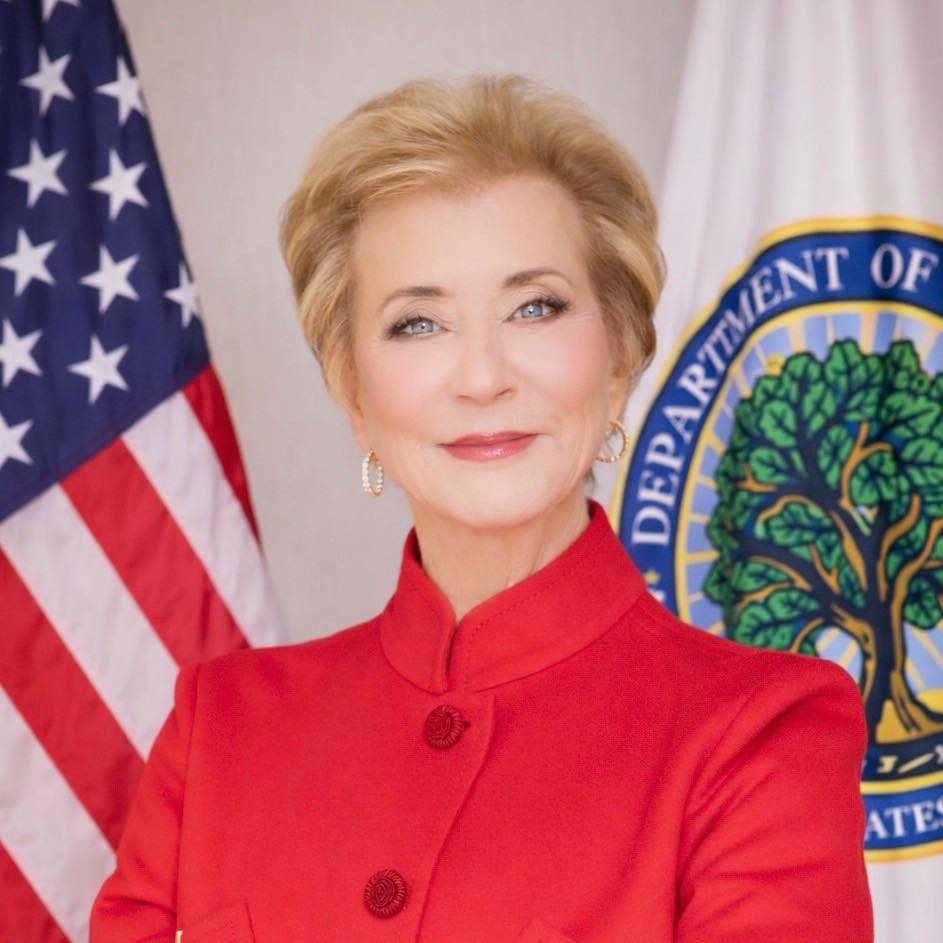
Secretary of Education. This profile tracks education policy, student aid, civil-rights enforcement and efforts affecting the Department of Education.
Current record notes: Current role: Secretary of Education in the Trump administration. FactFlag separates the officeholder’s own statements, the underlying government record, independent reporting and political interpretation.
FactFlag treats this page as a maintained public-record profile. Specific disputed factual claims are evaluated separately, with the original statement, primary evidence, contextual reporting and any material rebuttal shown together.
Role snapshot
Position & relationship
- Position / relationship
- Secretary of Education
- Affiliation / context
- Republican
- Directory
- White House
- Profile status
- Maintained public-record profile
- Service dates
- See role history
Role history & transitions
Documented current/future role notes
- Current role: Secretary of Education in the Trump administration.
- FactFlag separates the officeholder’s own statements, the underlying government record, independent reporting and political interpretation.
Evidence boundary
Fairness & uncertainty note
Profiles begin with official role/background information and expand only when a specific claim, statement, action, controversy or piece of media can be sourced well enough to review fairly.
Claims & evidence
Evidence tracker
Directly related evidence records
These records are stored once in the canonical evidence archive and surfaced here because this person is directly involved in the underlying action, agency, statement or dispute.
August 24, 2026 · Education / School choice / Federal scholarship tax credit · Directly related record
White House school-choice release gets the core federal tax-credit facts right, but its “nearly 52 million” eligibility figure needs sourcing context
DOCUMENTED PROGRAM / CONTEXT NEEDED — $1,700 CREDIT AND 30-STATE OPT-IN CONFIRMED; 52 MILLION FIGURE IS NOT AN IRS ENROLLMENT COUNT
Not rated on the thermometerThis related item is a policy/public-record development rather than a single rateable factual proposition.
Why it appears on this profile: As Secretary of Education, McMahon is a principal administration official for the school-choice and charter-school initiatives cited in the August 24 White House release. This link reflects departmental responsibility, not personal authorship of every White House statistic.
What is being said
At an August 24 back-to-school event, the White House said the Working Families Tax Cuts created the first nationwide federal school-choice tax-credit program, offering up to $1,700 for donations to scholarship-granting organizations; it said nearly 52 million students are eligible and that 30+ states have opted in or signaled intent. It also highlighted a $500 million Charter Schools Program investment.
What the record shows
IRS guidance confirms that Section 25F creates a federal tax credit of up to $1,700 for qualifying cash contributions to Scholarship Granting Organizations beginning January 1, 2027. State participation is voluntary. The IRS participating-state page listed 30 states with advance elections as of July 24, 2026, up from 27 in its June 8 news release. The Education Department separately documents a $500 million Charter Schools Program investment and describes it as the program’s largest investment. The “nearly 52 million students” figure is not an IRS count on the federal tax-credit pages reviewed; a school-choice coalition uses approximately 52 million as its estimate of potentially eligible students. Eligibility also depends on statutory household-income rules, state participation and qualifying SGO arrangements, so the estimate should not be read as 52 million students already receiving or guaranteed scholarships.
Assessment context: The central program mechanics are supported by primary federal sources: the $1,700 cap, 2027 start, voluntary state opt-in structure, 30 advance-election states and $500 million charter-school funding are documented. The broad 52 million figure is better treated as an advocacy/eligibility estimate rather than a current IRS beneficiary count. FactFlag therefore preserves the White House claim but adds the sourcing and implementation distinction.
Open canonical evidence record →
August 21, 2026 · Higher education / Law-school accreditation / Executive policy · Directly related record
Education Department moves to strip the ABA of federal recognition as a law-school accreditor
POLICY PROCESS — EDUCATION DEPARTMENT RECOMMENDS ENDING ABA FEDERAL RECOGNITION; FINAL DECISION PENDING
Not rated on the thermometerThis related item is a policy/public-record development rather than a single rateable factual proposition.
Why it appears on this profile: Directly related: as Secretary of Education, McMahon leads the department conducting the federal accreditor-recognition review and implementing Executive Order 14279.
What is being said
The Education Department says its staff review found the ABA accrediting council out of compliance with federal recognition requirements, including concerns about organizational independence and the pace of changes to diversity-related standards. The administration has also argued that ABA accreditation rules have promoted unlawful discrimination.
What the record shows
Reuters reported on August 21 that Education Department staff recommended revoking the ABA Council’s longstanding federal recognition. The Department’s current accreditation listings still identify the ABA Council as an active, federally recognized law-school accreditor with a 2026 review date. The Department’s published recognition process requires review beyond the staff recommendation before recognition can be terminated. Trump’s April 23, 2025 Executive Order 14279 expressly directed the Education Secretary to assess whether to suspend or terminate the ABA Council’s federal recognition and framed the administration’s objections around accreditation governance, outcomes and DEI-related requirements. The ABA disputes the Department’s conclusions and is expected to defend its recognition before the advisory committee.
Assessment context: The documented development is a staff-level federal recommendation, not a completed revocation. Describing the ABA as already stripped of federal recognition would be premature. The administration’s claims that particular ABA standards are unlawful or ideologically driven are its legal and policy position; the pending recognition process has not yet produced a final agency determination on termination.
Open canonical evidence record →