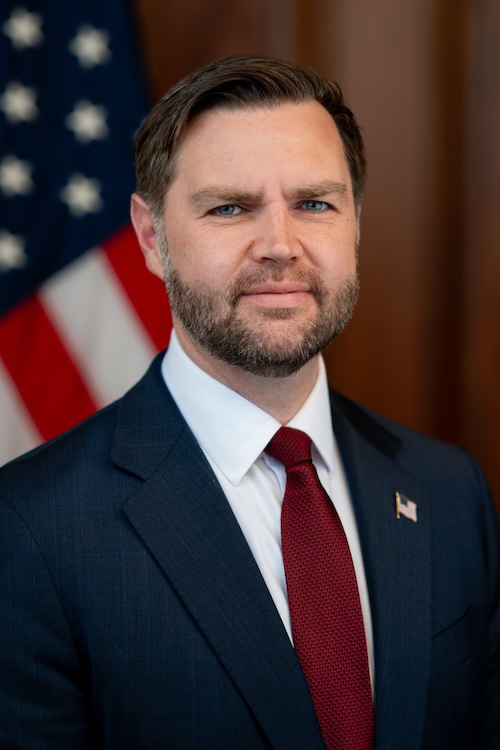
Biography
Background & current role
Vice President of the United States. This profile tracks public statements, policy arguments, speeches, interviews, votes from prior service where relevant, and claims made about or by the Vice President.
Current record notes: Current role: Vice President of the United States. FactFlag separates the officeholder’s own statements, the underlying government record, independent reporting and political interpretation.
FactFlag treats this page as a maintained public-record profile. Specific disputed factual claims are evaluated separately, with the original statement, primary evidence, contextual reporting and any material rebuttal shown together.
Role history & transitions
Documented current/future role notes
- Current role: Vice President of the United States.
- FactFlag separates the officeholder’s own statements, the underlying government record, independent reporting and political interpretation.
Claims & evidence
Evidence tracker
September 3, 2026 · U.S.-Iran conflict / terminology
Vance says he would not call the continuing U.S.-Iran conflict a war
CURRENT STATEMENT / TERMINOLOGY — ARMED HOSTILITIES ARE DOCUMENTED; “WAR” LABEL DEPENDS ON USAGE
Not rated on the thermometerThis item records a current statement/development whose legal or causal status is not reducible to a single evidence-gap score.
What is being said
At a White House briefing, Vance said he would not call the situation a war and described major combat operations as over while acknowledging continuing flare-ups tied in part to attacks on commercial shipping.
What the record shows
Reuters reported that the U.S.-Iran conflict had continued into a seventh month, with more than 50,000 U.S. troops in the region, continuing U.S. strikes and Iranian attacks affecting shipping in and around the Strait of Hormuz. The White House published the full September 3 Vance briefing video.
Limits / uncertainty: FactFlag does not treat the word “war” as a stand-alone factual switch. Formal declarations, War Powers questions, operational descriptions and ordinary-language use can differ. This record therefore separates Vance’s label from the documented existence of continuing armed hostilities.
September 3, 2026 · Iran strike / civilian-casualty investigation
Vance says U.S. is investigating a strike Iran says hit a wedding party
INVESTIGATION OPEN — U.S. REVIEW CONFIRMED; INDEPENDENT ANALYSIS POINTS TO A LIKELY U.S. MUNITION
Not rated on the thermometerThis item records a current statement/development whose legal or causal status is not reducible to a single evidence-gap score.
What is being said
Vance said the United States was investigating an airstrike that Iran said struck a wedding celebration in southern Iran.
What the record shows
Reuters verified imagery from the site and reported that weapons experts found the damage consistent with a direct hit rather than a ricochet or accidental detonation; several experts assessed that the munition was probably American. The Pentagon had not accepted responsibility at the time of the report and the U.S. investigation remained open.
Limits / uncertainty: The available evidence is significant but not a final official finding. FactFlag records the expert and visual analysis as independent evidence, while preserving the Pentagon’s unresolved attribution and the continuing investigation.
July 31, 2026 · Federal fraud enforcement / Task Force to Eliminate Fraud
Vance says the White House fraud task force identified $230 billion in fraud and halted $56 billion in fraudulent payments
SUPPORTED AS AN ADMINISTRATION-REPORTED LEDGER / INDEPENDENT AUDIT LIMITS — the figures are traceable to Fraud.gov, but not all dollars are adjudicated fraud
 38% evidence gapWELL SUPPORTED
NOT SUPPORTEDWhat is being said
At the July 31 Camp David Cabinet meeting, Vice President JD Vance said the White House Task Force to Eliminate Fraud had identified about $230 billion in fraud being perpetrated against Americans and had already halted $56 billion of it.
What the record shows
The White House subsequently published the same figures through Fraud.gov: nearly $230 billion in fraud uncovered, $56 billion in payments stopped, and more than $55 billion enforced through indictments, settlements and civil penalties. DOJ records confirm that a National Fraud Enforcement Division and related federal-state task forces were created during 2026 and have announced substantial enforcement cases. But the $230 billion and $56 billion totals are administration ledger figures, not a government-wide independent audit of individually adjudicated fraud. GAO has separately estimated annual federal fraud losses in a broad range of $233 billion to $521 billion and has stressed that government fraud measurement remains uncertain and inconsistent. The task-force totals are therefore documented as administration-reported measurements, but the public sources reviewed do not independently validate every dollar as confirmed fraud or a permanently prevented loss.
Response / rebuttal
The White House says Fraud.gov was created to make the task force’s work transparent and distinguishes among fraud uncovered, payments stopped and enforcement amounts. DOJ’s Fraud Division has separately published numerous criminal and civil cases supporting that significant enforcement activity is occurring.
Limits / uncertainty: “Fraud identified,” “payments stopped,” and “enforced” are different measures and should not be added together. Some amounts can represent estimated or alleged losses rather than adjudicated losses, and preventing a payment does not necessarily prove the entire payment would ultimately have been fraudulent. GAO’s government-wide fraud estimate uses a different methodology and time period and is included only as scale/context, not as validation of the task force’s specific totals.